I'm often
surprised by the variety of attitudes of fellow scientists to the sharing of
their data. ("What? And let other people mess with my data?!").
Friday, 13 March 2015
Sharing of Research Data : report

Thursday, 5 March 2015
Friday, 20 February 2015
Biodiversity principles and Roundtable Responsible Soy
Conversion and modification of habitat
for increased soy production is already a major pressure on biodiversity, and
is predicted to increase over the next decades, largely drive by the use of soy for feed for livestock.
I spotted a reference to the Roundtable Responsible Soy (RTRS) in a recent news item about Sustainable Soy and Food Waste Drive Progress in Netherlands: "Only soy meeting Roundtable Responsible Soy (RTRS) criteria is now being imported as part of the nation’s annual 300,000 tonne requirement, as of 1 January 2015, says the Dutch Dairy Association (NZO)."
I spotted a reference to the Roundtable Responsible Soy (RTRS) in a recent news item about Sustainable Soy and Food Waste Drive Progress in Netherlands: "Only soy meeting Roundtable Responsible Soy (RTRS) criteria is now being imported as part of the nation’s annual 300,000 tonne requirement, as of 1 January 2015, says the Dutch Dairy Association (NZO)."
The RTRS Standard for Responsible Soy Production is available
as a pdf and contains several principles for sustainable practice. Here are the
specific principles and practices that are relevant to biodiversity:
Tuesday, 17 February 2015
Key policy messages from EU CLAIM project
The CLAIM project aims to provide the knowledge base to support an
effective CAP policy design in the direction of improved landscape management,
particularly providing insights into the ability of landscape to contribute to
the production of added value for society in rural areas.
Wednesday, 11 February 2015
Publication: nitrogen yield advantage from grass-legume mixtures
Nitrogen yield advantage from grass-legume mixtures is robust over a
wide range of legume proportions and environmental conditions

Our latest publication from our international
collaboration COST Action 852 is in Global Change Biology, lead by Matthias
Suter of Agroscope in Switzerland. In it, Matthias used data on total nitrogen
yield from 16 international sites to investigate whether four-species (two grasses,
red clover, white clover) grass-legume mixtures can deliver more nitrogen in
forage per unit area (it did). We also investigated whether this benefit was related to the % of clover in
the sward - it was and it wasn't (!), but only because the benefit plateaued at a clover proportion of about 33% in the sward.
Tuesday, 10 February 2015
AnimalChange project: report on grass-legume mixtures
Quantification of the effect of legume proportion in the
sward on yield advantage and options to keep stable legume proportions (over
climatic zones relevant for livestock production)
Our report as part of the AnimalChange project is availabe on the project website.


Our report as part of the AnimalChange project is availabe on the project website.
KEY MESSAGE: Grassland systems using mixed grass-legume
swards have higher productivity and less environmental impact than their
respective monocultures. The positive effect of legumes on yield is most pronounced
with a mixture legume proportion of 30-60%.
Publication: Plant species of conservation concern in Ireland
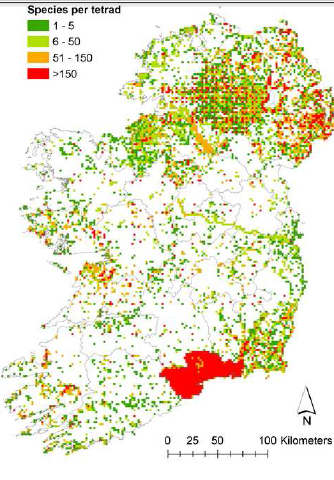
The distribution of vascular plant species of conservation concern in Ireland, and their coincidence with designated areas
This paper is now available as a pdf (until April 24 2015) at Journal for Nature Conservation.
It collates Irish (whole island) records (such as those collected by BSBI, and others) for species of conservation concern (such as Flora Protection Order species, Red Data Book species and others). We plot the distribution of plant species of conservation concern, and look at their coincidence with designated areas (Natura 2000, NHAs, ASSIs etc). As far as we're aware, this is the first time that this has been done in Ireland. Some counties are much better covered than others (see map below). This work showed that many of the records of species of greatest conservation concern occur within designated areas (average of 79%), but for individual species, this varied from 0% to 100%.
This paper is now available as a pdf (until April 24 2015) at Journal for Nature Conservation.
It collates Irish (whole island) records (such as those collected by BSBI, and others) for species of conservation concern (such as Flora Protection Order species, Red Data Book species and others). We plot the distribution of plant species of conservation concern, and look at their coincidence with designated areas (Natura 2000, NHAs, ASSIs etc). As far as we're aware, this is the first time that this has been done in Ireland. Some counties are much better covered than others (see map below). This work showed that many of the records of species of greatest conservation concern occur within designated areas (average of 79%), but for individual species, this varied from 0% to 100%.
Subscribe to:
Posts (Atom)